
Eleven Engineers Now Move More Than Double The Money Coinbase Does. Deep Dive on Hyperliquid.
Twice Coinbase’s notional volume. Eleven employees. $102M revenue per head. HYPE just hit an all-time high after three structural moves in May the market still has not finished pricing.

Our commitment to rigorous analysis stems from the reality that modern market disruption is increasingly driven by agile, nascent actors. Following discussions at the exclusive Consensus Conference’s Institutional Summit with representatives from the New York Stock Exchange and Nasdaq, Hyperliquid was on every lips and it was evident it is now viewed as a critical market participant, exerting sufficient pressure to command the attention of traditional finance's largest stakeholders - At only 2.5 years old. Deep dive.
Last year, the Hyperliquid exchange quietly processed $2.9 trillion in notional trading volume. Coinbase, the largest publicly listed crypto exchange in the country, processed $1.4 trillion over the same period. The exchange is called Hyperliquid. It has eleven full-time employees. In the last three weeks, HYPE went from $40 to a $64.59 all-time high, the market capitalization broke $14B, and the first two US spot ETFs began trading on the New York Stock Exchange and Nasdaq.
This is not a narrative about decentralization winning a culture war. It is an engineering and economics story with implications for how derivatives exchanges get valued, how the CLARITY Act and Project Crypto rulemaking reshape the US market, and why a small team running a purpose-built Layer 1 blockchain has quietly built what is now, by most measures, the most capital-efficient trading venue ever constructed.
The thesis: Hyperliquid is not a better decentralized exchange (DEX). It is a better exchange. Its structural advantages over both centralized exchanges (CEXes) and rival DEXes are durable, and its revenue flywheel is unusually direct for a crypto-native business. The HYPE token captures that cash flow through a 99% fee-to-buyback mechanism, and as of May 14, 2026, a second cash flow source: Hyperliquid extracted up to 90% of USDC reserve yield from Coinbase and Circle under the new AQAv2 framework, adding an estimated $135M to $160M in annualized buyback fuel on top of trading fees. The regulatory picture has continued to improve: the CLARITY Act cleared the Senate Banking Committee on May 14 in a 15-9 bipartisan vote, SEC Chair Paul Atkins delivered a second major speech on May 8 outlining formal rulemaking pillars for onchain markets, and the first two US spot HYPE ETFs launched in mid-May. HYPE trades at roughly 14x to 16x annualized protocol earnings against a comparable-equity peer set in the 24x to 37x range. Like in all our deep dives, we will also cover the bear case that has to do with regulatory tail risk, validator concentration, policy reversibility under a future administration, and a reflexive buyback model that works beautifully until volume stops rising. We are positioned in HYPE and remain so, sized to navigateha the scenario the market is not pricing.
Why an 11-Person Team Can Beat a 5,000-Person Exchange
(Disclosure: The author and/or affiliated entities hold positions in HYPE and in the broader digital asset complex discussed in this analysis. See full disclosure in the disclaimer below.)
Most investors evaluate exchanges the way they evaluate banks: by headcount, licensing footprint, institutional relationships, and marketing reach. That framework is roughly thirty years out of date. A modern derivatives exchange is a matching engine, a risk engine, a settlement layer, a liquidity layer, and a client interface. Every one of those layers can, in principle, be code.
Hyperliquid answered that by building its own Layer 1 blockchain specifically for trading. Not a smart contract application on somebody else’s chain. A purpose-built distributed system called HyperCore, running a consensus protocol called HyperBFT, paired with an Ethereum-compatible execution layer called HyperEVM. The result is a fully on-chain central limit order book (CLOB) that processes roughly 200,000 orders per second with sub-second finality, median latency around two-tenths of a second. That is competitive with CME Group and materially faster than any other decentralized venue, achieved without custody of user funds and without the regulatory fixed cost that centralized exchanges carry.
The ratio matters. Binance processes $40B to $56B per day in derivatives with tens of thousands of employees. Coinbase has roughly 5,000 employees and $1.4T in annual notional 2025 volume. Hyperliquid does almost twice Coinbase’s volume with a team that could fit around one conference table.
The Volume Picture
The 2025 totals make the comparison plain. Hyperliquid’s notional trading volume was $2.9T versus Coinbase’s $1.4T. The gap widened through the back half of the year as Hyperliquid’s perpetual business compounded while Coinbase’s spot volumes cooled.
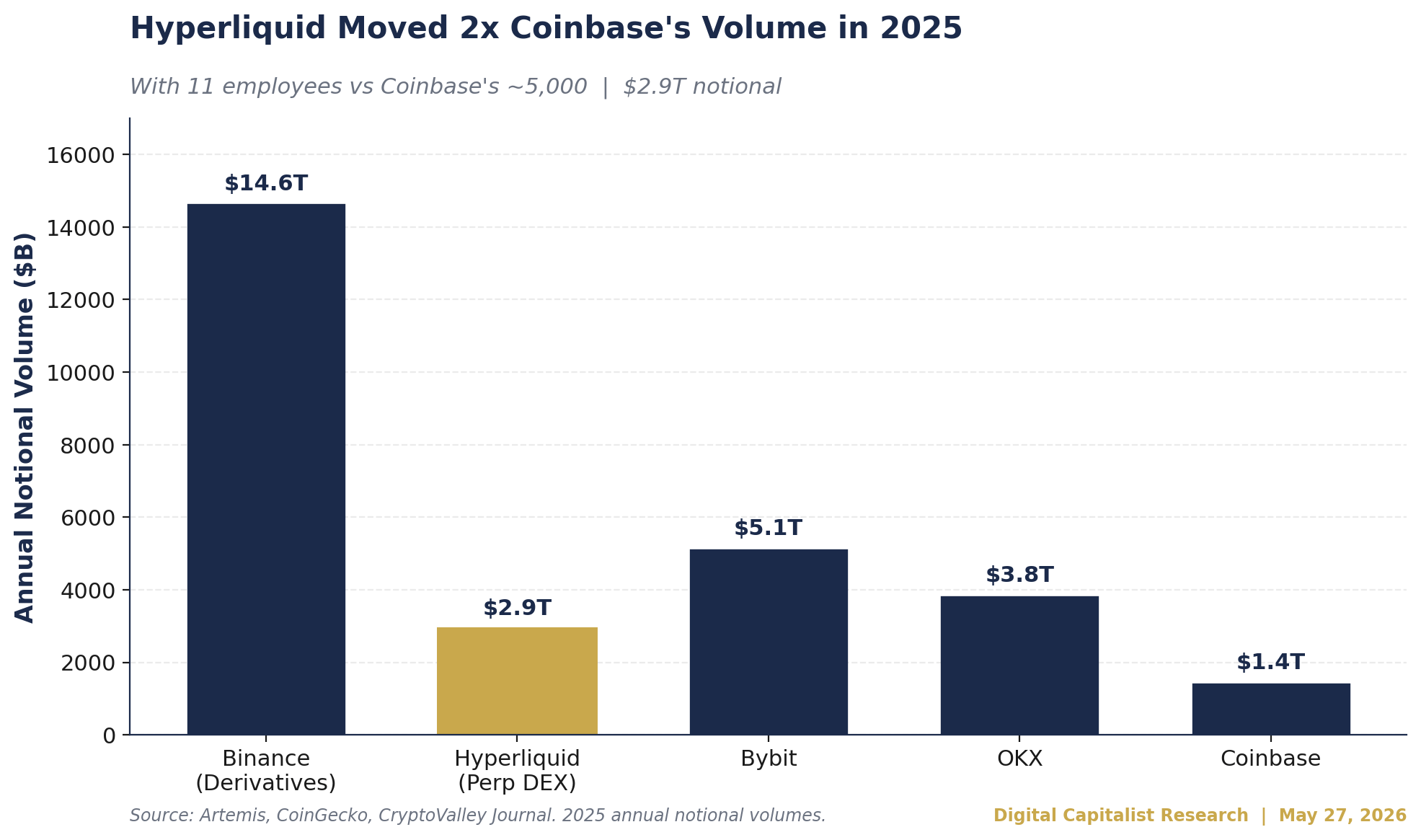
Against Binance, Hyperliquid still trades at a fraction of the scale. Binance handles around 35% of all centralized perpetual volume. Hyperliquid currently runs at roughly 14% to 15% of Binance’s perp throughput, up from 8% at the start of 2025. Against Bybit it is 32%. Against OKX, 24%. Against total centralized exchange perp volume, Hyperliquid now handles about 6% to 7% of global flow on any given day.
That figure is the one to focus on. Three years ago, decentralized exchanges represented less than 2% of total perpetual futures volume globally. By the end of 2025 that share was above 20%, per CoinGecko. Hyperliquid alone now accounts for approximately 60% of on-chain derivatives open interest globally. Inside a multi-trillion-dollar global perpetuals market, the share shift from centralized to on-chain venues is one of the cleaner secular signals in crypto.
The intra-2026 trajectory has accelerated rather than slowed. Trailing 30-day perpetual volume printed at $214.87B as of late May. Trailing seven-day perpetual volume reached $51.7B. Cumulative perpetual volume since launch has crossed $4 trillion. The user base has grown from roughly 300,000 in early 2025 to over 1.4 million by early 2026 and continues to compound through the ETF and AQAv2 catalysts. Staggering momentum to say the least.
A note on volume integrity: Coinglass has flagged that some perp DEXes inflate reported volume through incentive-driven wash activity. Hyperliquid’s volume survives the filter: The platform’s ratio of open interest to volume, sustained dominance in liquidations, and continued open interest above $5B even during quieter market periods all indicate real capital at risk rather than fee-farming rotation.
